
 German (DE)
  English (US)
  Spanish (ES)
  French (FR)
  Hindi (IN)
  Italian (IT)
  Russian (RU)
  21 hours ago
10 hours ago
Marie-Louise ConnollyHealth correspondent, BBC News NI

 BBC
BBC
Aimee Oliver is due to undergo pelvic floor surgery
Fitness fanatic Aimee Oliver never imagined that giving birth would ultimately cause her to need surgery for incontinence.
Now aged 37, Aimee's problems began in her 20s, when she began to leak urine after coughing or sneezing following the birth of her first child.
"When my body stopped working as it should I actually began to mourn my old self," she said.
Northern Ireland's five regional health trusts said more people were seeking help for incontinence, and a specialist nurse said there had been a "massive increase" in self-referrals from both men and women.
Aimee - a personal trainer, fitness fanatic and volleyball champion - has qualified for the women's Pro Hyrox World championships for the second year.
She said the condition was mentally and physically debilitating - an irony as she runs a group that helps women build strength and fitness, especially after birth.
Incontinence is the involuntary or accidental loss of bladder (urinary) or bowel (fecal) control, ranging from minor, occasional leaks to complete loss of control.
It is a common symptom of underlying issues, including weak pelvic muscles, neurological disorders, and infections.
Aimee said leaking was "extremely embarrassing" and it was a reason why many women give up exercising or stop going out socially.
She described some of the measures she had to take to stay active.
"In a recent competition in Belfast, I won overall female, but I was leaking while competing and wondering, 'can people see my shorts are wet?'
"That when I am running there is urine running down my legs and I can only ever wear black shorts to try and hide the wet marks.
"I am wearing thick shorts, pads, pessary and a device, and I am still leaking visibly – it just adds to the stress of competing," Aimee said.
A mum of three, Aimee believes that women in Northern Ireland are not supported properly after they give birth, as postpartum physiotherapy is not routinely offered.
She said her personal training clients in France, Spain and Sweden describe a more supportive post-natal support system being in place for several months.
"In some countries the whole way through pregnancy and after they automatically have physio appointments - often 10 sessions post birth and that can make a massive difference to a woman's health in the long-term," Aimee said.
She is due to undergo pelvic floor surgery in the private sector as she has been told she would have to wait at least six years within the NHS.
"At 37 I am at the peak of my competition fitness, so I don't have six years to wait," she said.
What are pelvic floor muscles?
Pelvic floor muscles are a sling-like layer of muscles spanning the bottom of the pelvis, crucial for supporting the bladder, bowel, and uterus.
They control the release of urine, faeces, and flatus, and play a role in sexual function. Strengthening these muscles helps prevent incontinence and organ prolapse.
Self- referral to health trusts
Continence specialist nurse Julie Edmonds said incontinence was "extremely common" and there had been a "massive increase" in self-referrals among men and women in the South Eastern Trust where she works alongside four other specialist nurses.
"It can affect anybody, any gender, any age, we are treating men and women from as young as 18 to most recently a woman in her early 100s.
"We are definitely seeing a shift especially among younger women who are just not accepting that because they've had children, or the menopause they have to put up with it.
"They are starting to realise that there is something that can be done and they are coming forward for help," she said.

Julie Edmonds is a continence specialist nurse
While childbirth is the most common reason for a weakened pelvic floor, Julie said people's drinking habits were another factor.
"We have a massive coffee culture now and people don't realise the impact coffee has on their bladder muscle which can cause increased urinary frequency," she said.
"So simple things like swapping for decaf, also swapping fizzy drinks, alcohol, even green tea, for water and diluted juices will, after two weeks, make a massive improvement."
Northern Ireland's largest health trust, Belfast, said it had seen a 25% increase in monthly referrals since 2020.
Demand is outstripping service availability, according to the trust, which means a six-week wait for urgent referrals and 13 weeks for routine referrals.
None of the health trusts were able to provide waiting list figures, however the South Eastern Health Trust said its waiting time was approximately 18-20 months for routine appointments and about 12 weeks for urgent referrals.
In the Western area there has been a 13% increase in the trust's pelvic health physiotherapy service.
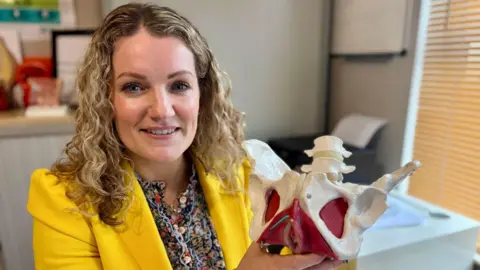
Gráinne Donnelly is a pelvic health physiotherapist
Gráinne Donnelly's work is all about pelvic health and encouraging people to train their pelvic floor muscles.
In the middle of her doctoral research, the advanced practice pelvic health physiotherapist said greater emphasis on long-term pelvic health would support people and the health service.
"One in two women withdraw from their sport and that includes in their younger teens - and that drop off could partly be to do with issues around pelvic floor.
"If people are withdrawing from sport that is a public health priority. We need physical and cardiovascular activity for both our physical and mental health so we shouldn't let our pelvic floor function decline," she said.
Gráinne and Julie both said there was high-quality evidence that most women would be cured with pelvic floor muscle training alone and, if done properly and early, it can mean surgery is avoided.
Aimee believes more knowledge around pelvic health and support for women after giving birth will save the health service money in the long run.
"Pelvic muscles are just like any other muscle in the body which need exercised. If you don't stay on top of them, it can have big consequences as we get older," Aimee said.



















Comments