
 German (DE)
  English (US)
  Spanish (ES)
  French (FR)
  Hindi (IN)
  Italian (IT)
  Russian (RU)
  2 hours ago
On a cold Saturday morning, a little over a week before the New York City mayoral election in November, I was at a park in Queens to speak at a fundraiser for Asiyah Women’s Centre, the oldest and largest shelter providing support for American Muslim female victims of domestic violence. Vendors selling everything from chai to embroidered Palestinian handicrafts turned out to support the fundraiser; a DJ blasted music and artists painted children’s faces with the colours of Halloween.
I chose the vendor with the most protein on offer because I lift and squat more than my bodyweight and must meet a daily goal. “Our kebab is one of Zohran’s favourites,” the man at the King of Kebab stand told me, proudly and unprompted, as he piled my plate with meat.
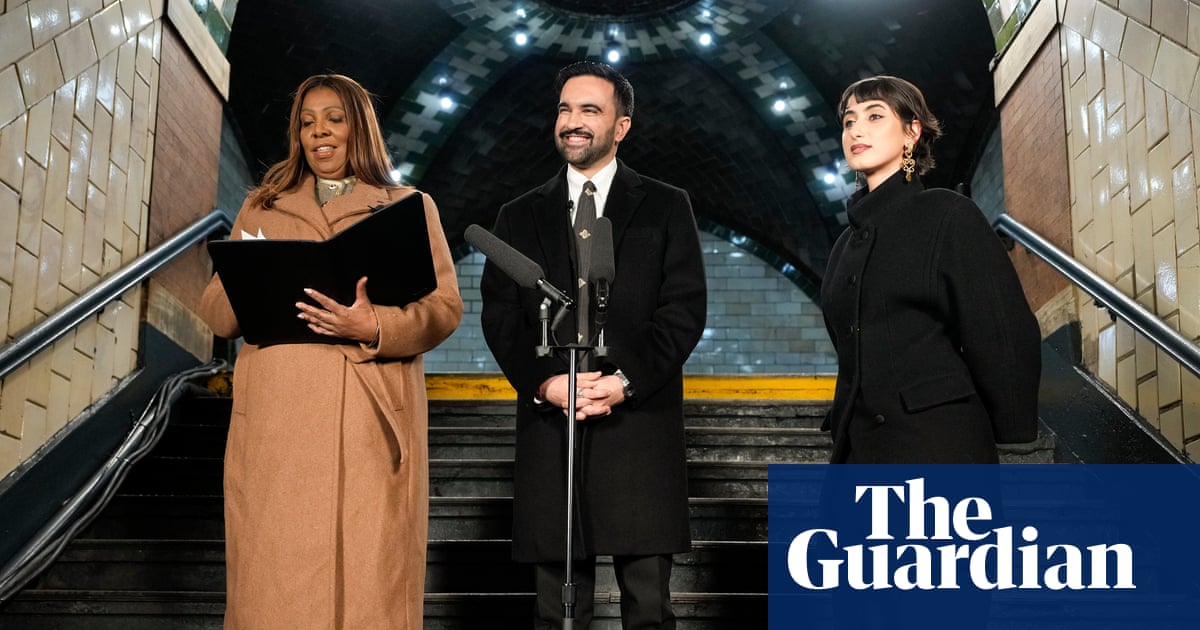
I had not asked him anything about the mayoral race but I knew exactly who he meant, because like Cher, Madonna, Beyoncé and Björk, our mayor-elect is simply Zohran to many of us. And not because we can’t pronounce his family name – I’m looking at you Andrew Cuomo and all who seem to deliberately mangle “Mamdani”. In New York City, and everywhere else I’ve been, 2025 was the year when everybody learned his name. And after he is sworn in today on the steps of City Hall – followed by a party for 40,000 in Lower Manhattan – 2026 will be the year of Zohran.
I’ve been a New Yorker for 23 years. During that time, I have travelled across the world to give lectures and I’ve never been asked what I think of Michael (Bloomberg), Bill (de Blasio), or Eric (Adams) – our mayors since I moved here. None of them has come close to encapsulating the arduous and necessary complication of identity that many New Yorkers feel in this city of a million Muslims. But ever since he announced his mayoral candidacy at the end of 2024, Zohran has seemed to represent something that my life has bumped up against many times since I have lived here.
I’ve spent 19 of my 23 years in NYC in Harlem, where I live in a rent-stabilised apartment in a brownstone owned by a Black woman from the neighbourhood. Mamdani campaigned as an ally to tenants like me, vowing to freeze rent for 2 million people living in rent-stabilised apartments as part of his focus on affordability. A few weeks before we went to the polls, my landlady and I were catching up in the hall outside her apartment. “I hope you’re voting for Zohran,” she said.
During my citizenship oath in NYC in 2011, we were told that in the hall for the ceremony were people from 140 countries about to become US citizens. Few other cities hold the allure of New York in the global imagination. And few other Muslims have reached Mamdani’s level of first-name celebrity status, or the ability to complicate the narrative of what a Muslim is. I am an avowed consumer of cannabis and I cheered Mamdani’s response during the mayoral debates when candidates were asked if they had ever bought marijuana, which is legal in New York. “I’ve purchased marijuana at a legal cannabis shop,” Mamdani replied, with a big cheesy grin. Fuck, yeah, Zohran!
I moved from Egypt to Seattle in 2000, and then to New York City a year after the September 11 attacks. Soon after arriving, I found community with Muslims and we began to call ourselves progressive Muslims. Unlike me, most of them had been born and raised in the US. Those who did not wear hijabs spoke often of how the 9/11 attacks forced an unfamiliar visibility upon Muslims, who comprise less than 2% of the US population. That was especially the case for those whose families were more recent arrivals, compared to Black Muslims who have been in the country as far back as the days of enslavement. “I came out as Muslim after 9/11,” one of my new friends told me at the time, adding that his neighbours and colleagues had assumed he was Latinx. Over the years since, I have lost count of the number of “No hablo español,” that I’ve issued across the city because I’m often thought to be Dominican or Puerto Rican.
Mamdani lives in Queens, the site of the fundraiser for the Asiyah Women’s Centre. “The capital of linguistic diversity, not just for the five boroughs (of New York City), but for the human species, is Queens,” Rebecca Solnit and Joshua Jelly-Schapiro wrote in Nonstop Metropolis: A New York City Atlas. There are as many as 800 languages spoken in New York City, and nowhere in the world has more than Queens, according to the Endangered Language Alliance.
Donald Trump, whose regime plans to ramp up efforts in 2026 to strip naturalised people of their US citizenship, is also from Queens. As is Republican New York City councilwoman Vickie Paladino, who called for the “expulsion of Muslims” in the wake of the Bondi Beach massacre. In a year when their politics had begun to feel undefeatable, Zohran’s win is a breath of hope.
Mamdani excites so many, in the US and abroad, because to co-opt and misquote Robert Frost, he is the more enticing of the two roads diverging in Queens, and across the US at the moment. He makes more urgent – and youthful – the choice to embrace social justice and reject hate and nationalism at a time when older politicians are succeeding in their bigotry and chauvinism. He will become the city’s youngest mayor since 1892, its first Muslim mayor, and its first mayor born on the African continent. It feels apt that New York is the city that first embraced him.
The year after I moved to New York City, my brother and his wife had a daughter – my own immediate family’s first US citizen. Ten years after I moved to NYC, I was arrested for spray painting over a racist, Islamophobic, pro-Israel advertisement in the subway. I did it because I did not want my niece and her three siblings or any other American Muslim children to be bullied or to have to choose – as the racists and Islamophobes insist – between being American and Muslim.
And now, here in NYC, I can point to Zohran!
-
Mona Eltahawy writes the FEMINIST GIANT newsletter. She is the author of The Seven Necessary Sins for Women and Girls and Headscarves and Hymens: Why the Middle East Needs a Sexual Revolution








Comments