
 German (DE)
  English (US)
  Spanish (ES)
  French (FR)
  Hindi (IN)
  Italian (IT)
  Russian (RU)
  3 hours ago
As we mark the 81st anniversary of the end of the second world war in Europe this Friday, 8 May, it’s clear that Germany will again be the leading European military power.
Already next year its defence spending will be as much as that of France and Britain combined – and it is projected to be significantly larger by 2030. The German government’s declared goal is to have the strongest conventional army in Europe. True, France and Britain have nuclear weapons, but that means less money to spend on the rest of defence. So the question is not, will this happen? Barring unforeseen developments, it will. The question, particularly on this solemn anniversary, is: how can we ensure that this time the growth of German military power is a positive development for all of Europe?
There are two reasons Germany has made such a radical departure from the (increasingly mistaken) stance it took all the way from the hopeful 1990s to Vladimir Putin’s full-scale invasion of Ukraine on 24 February 2022. The first is precisely that Russian aggression. In Berlin, there’s a growing consensus that Putin won’t stop at Ukraine. The second is that the US president, Donald Trump, has now put in question the entire American commitment to the defence of Europe, as manifested through Nato since 1949. The recently announced withdrawal of 5,000 (and possibly more) US troops from Germany is just one more sign of that. The announcement rather than the move itself was triggered by Trump’s personal pique at the German chancellor Friedrich Merz’s criticism of his disastrous war against Iran.
The obvious challenge this leaves for Europe is whether we can deter an aggressive, nuclear-armed Russia on our own. (The “we” here must include Ukraine, which has the largest, most battle-hardened army in Europe.) The less obvious but equally important challenge is how to avoid the return of those acute tensions about the distribution of military power between European countries, which were both the normality and the curse of Europe until 1945. As a largely benign military hegemon, the US protected us from the one as much as the other.
Germany is pivotal to answering both questions. Its new military strategy, the first in the history of the Federal Republic, is titled Responsibility for Europe. But “for Europe” is just words. Everyone in Europe (except the British) says that about their national policy. The real issue is whether this will be European in deed.
The key areas in which European answers need to be found are the defence industry and our actual war-fighting capabilities. Defence technology and production are the nerves and muscles of military power. Germany’s 19th-century chancellor Otto von Bismarck is always misquoted as recommending “blood and iron”, but the historian Peter Wilson reminds us that what Bismarck actually said, when asking a Prussian budget committee for increased defence spending in 1862, was “iron and blood”. First came the iron, then the blood. Wilson also points out that even before 2022, although Germany had run down its own military and was still fervently preaching appeasement of Russia, it was already one of the world’s largest arms exporters.
If Germany goes on investing its massively increased defence expenditure in its own national defence industry (while gradually reducing purchases from the US) it could eventually overtake France, which is second only to the US as a global arms exporter. France is particularly worried about this. With exquisite Cartesian logic, Paris interprets “European sovereignty” to mean: don’t buy American, British or German – buy French! Or at least, Franco-German; but the biggest joint Franco-German project, the Future Combat Air System, is falling apart.
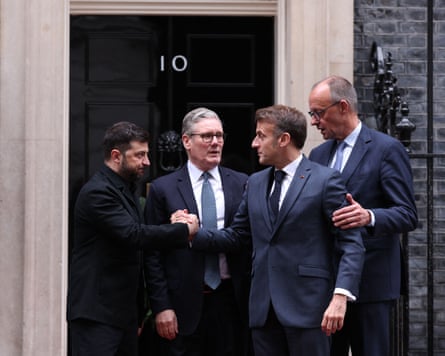
Yet it’s not only the French who are concerned about the prospect of German defence-industrial dominance. The Polish right is hysterical about it. Other Europeans are also beginning to feel uncomfortable. Their discomfort is heightened by the prospect of the nationalist-populist Alternative für Deutschland (AfD), which currently leads in national opinion polls, taking charge of a mighty military. Actually, the AfD is most likely to revert to appeasement of Moscow. But who knows where German politics will be at the end of the military strategy’s 2035 mid-range planning horizon? After all, no one could have imagined a decade ago that in 2026 the AfD would be the most popular party in Germany.
There are strong forces pushing the German government to spend its billions at home. The country’s entire export-based business model is in crisis, and this is one of the few remedies to hand. Some of its famous car factories are already being converted to weapons production. Moreover, any item of defence procurement above €25m must be authorised by the Bundestag’s budget committee. This is a perfect recipe for pork-barrel politics, with MPs and parties insisting on spending in their own electorally sensitive regions.
As for war fighting, the hard reality is that the defence of Europe today depends on the US-led Nato. Its battle plans provide for a vast machine to spring into action if Russia attacks anywhere down Nato’s eastern flank. Multinational brigades in frontline states would rapidly be reinforced by the rest of the alliance. This response rests at every level on the US, from satellite intelligence and heavylift aircraft through integrated air defence, and command and control, all the way to nuclear deterrence. Achieving even a halfway credible Europeanisation of this formidable machine is at once an essential and a daunting task.
So where to begin? This summer, Merz should sit down for an informal working dinner with the French president, Emmanuel Macron, the UK prime minister, Keir Starmer (or his successor), and the Polish prime minister, Donald Tusk. They should discuss, frankly and practically, the key questions: how to Europeanise the defence industry and how to enhance Europe’s own war-fighting capability. On the former, it’s simply ridiculous that where the US has 33 main weapon systems, Europe has 174 – including 12 different kinds of tank and 14 kinds of combat jet. On the latter, the first step is just to work out where and how to have that conversation, which must include the issue of extending British and French nuclear deterrence eastwards.
In the 1990s, Merz’s great predecessor, Helmut Kohl, embedded a newly united Germany in a European single market and monetary union. No country benefited more than Germany itself. Merz should aim to do the same for European security. The solutions will be nothing like as tidy as the single market and currency – and not even mainly inside the EU. At the end of the day, the tests will be these: in the minds of Germany’s neighbours, will there be a genuinely integrated European defence industry or still just rival national ones? And will our Europe-alone military preparations, however messy and imperfect, prove a sufficient deterrent in the mind of Putin?
If Merz, working together with other European leaders, can find convincing answers to these two questions, he will gain a secure place in the history books.
-
Timothy Garton Ash is a historian, political writer and Guardian columnist. His books include In Europe’s Name: Germany and the Divided Continent











Comments