
 German (DE)
  English (US)
  Spanish (ES)
  French (FR)
  Hindi (IN)
  Italian (IT)
  Russian (RU)
  2 hours ago
Millions of people around the world are having their lives upended by floods, storms and heatwaves worsened by the climate crisis. Those forced to flee their home countries, however, are finding that the door to the US is more firmly shut than ever.
Neither US nor international law recognizes environmental hazards, such as climate-related displacement, as a valid cause to claim asylum or gain entry through other migration pathways, despite the mounting toll of disasters caused by an overheating planet.
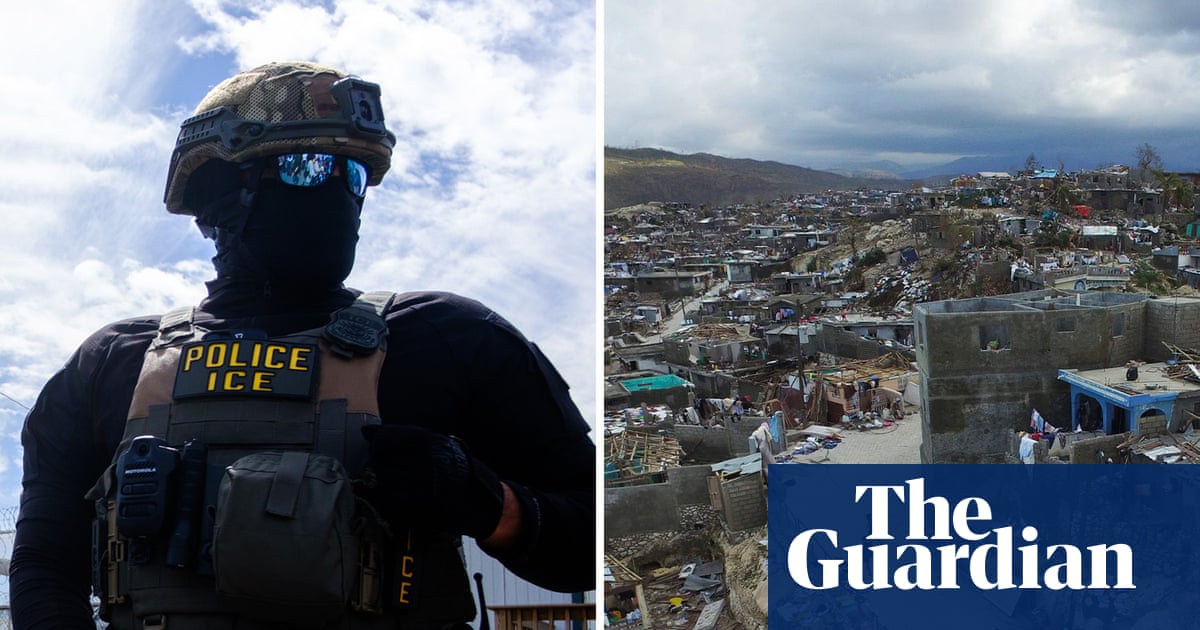
But those who have managed to get to the US through other means after being displaced in this way now find themselves in an even more precarious position following Donald Trump’s immigration crackdown, with little hope of a new system to help others forced from their homes by climate impacts.
For some, that pathway to the US has been particularly perilous. When Hurricane Mitch crashed into Honduras, killing 7,000 people, one affected family surveyed the unsalvageable ruins of their home and realized they had a lifeline – to move to the US.
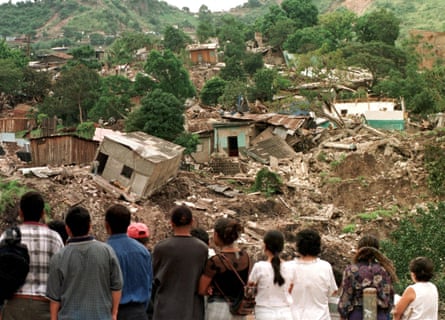
Evelyn, who does not want to share her full name, was a teenager when Mitch hit in 1998 and recalled how her relatives in New York City pleaded with her mother to bring her and her sister to the US.
“There were bodies and dead animals floating in the water, the house was messed up, the furniture was all gone – doors, windows gone. It was so, so sad,” said Evelyn. “I got sick because of the mosquitoes and didn’t have any services to rebuild the house because our country is very poor. My uncle and aunt were just like, ‘OK, just bring the kids over here, don’t stay. It’s dangerous.’”
Storms of the deadly ferocity of Mitch are even more likely now because of a hotter atmosphere and ocean that has rapidly heated up from the burning of fossil fuels.
Yet Trump’s migration crackdown has made it far harder for people like Evelyn to flee to the US now. “Every day it’s more barriers,” said Evelyn, who still lives in New York and has two daughters, one studying to be a lawyer, the other a doctor. “It’s sad to know that people will not be able to apply for a status or something to help their situation and also help the people back home.”
Some migrants in the US have faced living in countries rocked by climate shocks and conflict.
“I was invited to come here and be part of this country and now all of a sudden you try to make me go back after establishing a life here?” said a doctor from Sudan, who moved to the US several years ago and did not want to be named. The doctor faces the prospect of deportation under a new Trump administration edict that has blocked all entry to the US from Sudan and dozens of other countries.
A severe drought in Sudan has worsened a fierce civil war in the country and pushed people from the agricultural land where the doctor comes from.
“People have had to abandon their lands because there isn’t enough water, millions have fled,” he said. “There is climate change and the difficulty of people sharing resources and the conflicts are affected by that. I would rather stay home and do my medical training here but many factors forced me to leave the country.”
Droughts are being exacerbated by rising global temperatures, researchers have found, and a leading cause of the 250 million people worldwide who have been displaced by environmental factors in the past decade, according to the United Nations.
Displaced people in certain countries can also be affected by wars or fall victim to gangs or other violence as a result of their movement. These secondary impacts are often the ones that compel them to flee over international borders and gain sanctuary elsewhere.
“It was always hot, no rain,” said another man, from Somalia and now applying for asylum in the US, about the drought in his own country. Somalia, like Sudan, has been racked by civil war.
“People from the farming lands, they’re dying, with no water,” he added. “Also the animals, they die because when it’s not raining, everything will dry, people die, animals die, and all the people they run from the farm and come to the city. So everything can get hard.”
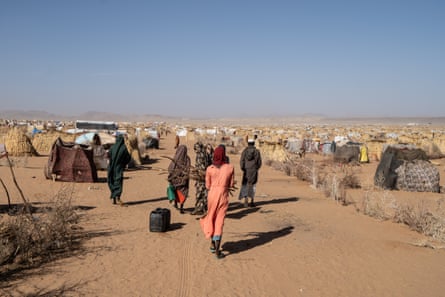
After being forced from bone-dry farmland to Mogadishu, the man said he came to fear for his life due to armed groups that were bombing markets and forcing children to become soldiers, so he became a refugee. He now faces new fears in the US after the Trump administration effectively shut down the asylum system, other than to white South Africans.
“Now we are getting a lot of attacks from the government,” the man said. “I don’t know why. I don’t understand what the problem is. It’s scary with the government here, how they are treating people.”
People uprooted from countries like Sudan and Somalia now face an almost impossible situation in terms of entry to the US, according to Felipe Navarro, associate director of policy and advocacy at the Center for Gender and Refugee Studies.
“If you were displaced by climate change, that door is closed,” he said. “I don’t think climate displacement comes into the administration’s thinking; it’s probably not intentional. They just have a general hatred for certain nationalities and races. This administration doesn’t really care about climate change at all.”
Some Democratic lawmakers have in recent years attempted to introduce a climate-related visa that would cover people fleeing extreme weather disasters. However, with the political mood swinging strongly against migrants, advocates’ hopes of reform have dwindled, even as the number of displaced has ballooned.
“It’s hard to predict the long-term effects of these policies,” said Navarro. “When we close doors, though, people always find another path to move.”
-
The Guardian receives support for visual climate coverage from the Outrider Foundation. The Guardian’s coverage is editorially independent









Comments