
 German (DE)
  English (US)
  Spanish (ES)
  French (FR)
  Hindi (IN)
  Italian (IT)
  Russian (RU)
  3 hours ago
Nick TriggleHealth correspondent

 Getty Images
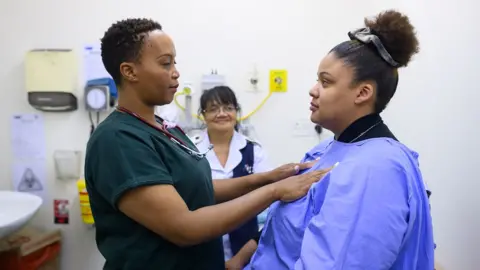
Earlier diagnosis and faster access to treatment is a core part of the government's plan (generic photo)
Earlier cancer diagnosis and faster treatment are being promised under a government plan in England to ensure three quarters of patients are surviving cancer for at least five years by 2035.
Ministers say the ambition being outlined in their cancer strategy on Wednesday will herald the fastest improvement in cancer outcomes this century.
Latest data for 2022 shows five-year survival at 60%, leaving the UK lagging behind other developed countries.
To help achieve the goal, the government will pledge to hit the 62-day waiting time target by 2029 - it is more than a decade since it was met.
But experts warn it will require significant extra investment, particularly in staff, to make improvement.
However, Health Secretary Wes Streeting, who has survived kidney cancer, is adamant the plans are achievable.
He said the investment being made in the NHS by the government – the budget is increasing by 3% above inflation in the coming years – coupled with advances in medical science and technology will help "transform the life chances of cancer patients".
Speaking ahead of publishing the strategy on Wednesday, Streeting added: "Cancer is more likely to be a death sentence in Britain than other countries around the world. But survival shouldn't come down to who won the lottery of life.
"As a cancer survivor who owes my life to the NHS, I owe it to future patient to make sure they receive the same outstanding care I did."
Improving early diagnosis is seen as crucial – currently just over half of cancers are diagnosed at stages one and two, which provides the best opportunity to treat the disease. The proportion has improved little in the past decade.
Steps to identify more cancers through screening will be outlined – currently only 6% of cases are.
The government has already said it will lower the threshold at which bowel cancer screening triggers further checks to help identify more cancers.
A targeted lung cancer screening programme is also being rolled out for ex-smokers.
- Deliver 9.5 million more tests and scans by 2029
- Rapidly increase the amount of precision robotic surgery being carried out
- Treat more rare cancers, such as brain cancer, in specialist centres in a bid to improve outcomes
- Expand genetic testing so more patients benefit from targeted treatment, such as immunotherapy, for their specific type of cancer
The pledge to hit the 62-day waiting time target is being seen as particularly challenging. Currently around 70% of patients start their treatment with this timescale, but the target is 85%.
There are another two targets that form part of that – a 28-day target for diagnosis, which is being met, and a 31-day target for treatment to start, which is being missed.
The Royal College of Radiologists said there were insufficient specialist cancer staff to meet demand.
Workforce surveys suggest there is a 30% shortfall in radiologists and 15% in clinical oncologists - doctors that oversee non-surgical cancer treatments such as chemotherapy and immunotherapy.
"Plans to diagnose and treat cancer faster are welcome, but without sustained investment in the specialist workforce, there will not be enough doctors to deliver timely and effective care for patients," added college president Dr Stephen Harden.
Cancer Research UK chief executive Michelle Mitchell said the promises represented a "significant commitment" that would require a "wide range of measures".
"England lags behind comparable countries on cancer survival – it's vital that changes," she said.
Five-year survival data analysed by the charity shows the UK consistently lags behind on cancers of the stomach, colon, pancreas, ovaries and lungs.
For example, on colon cancer five-year survival exceeds 70% in Australia, while in the UK it is under 60%.
For lung cancer, 15% of UK cases live five years, but in Norway and Canadamore than 20% do.
Gemma Peters, of Macmillan Cancer Support, said: "People living with cancer tall us all too often that their care hasn't been good enough, from long waits for tests and treatment to being left without the support they need once treatment ends."
She said it was encouraging to see such "bold ambitions" which had the potential to transform care.











Comments