
 German (DE)
 English (US)
 Spanish (ES)
 French (FR)
 Hindi (IN)
 Italian (IT)
 Russian (RU)
 2 hours ago
A seven-year-old girl who was arrested by federal immigration agents alongside her mother in suburban New Orleans – then sent to a family detention center in Texas – has written a letter asking Donald Trump to release her from custody, saying she wants to see her dad again and continue her academic education.
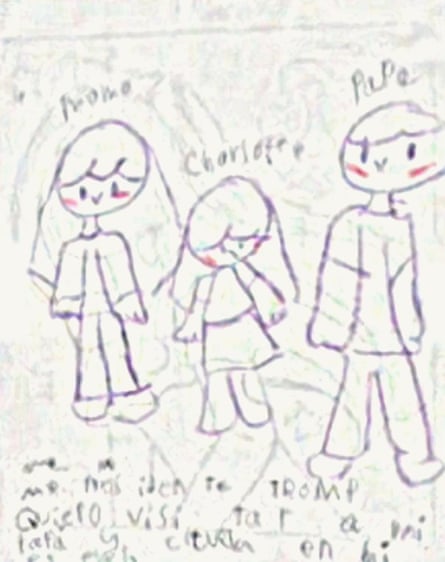
“Mr President Trump, I would like to visit my father, and study at my school,” Charlotte Ortiz said in the letter she wrote in Spanish from inside the Dilley, Texas, immigration processing center after her and her mother’s detentions in late October.
The letter, a photograph of which was shared with the Guardian by independent reporting outlet Perdido Street News, also had hand-drawn figures of Charlotte; her “mama”, Karen; and her “papa”, Bruno.
Nonetheless, when recently asked about Charlotte and Karen’s detentions, a Trump administration spokesperson said there was a final order of removal for the mother after the family arrived from Venezuela seeking asylum in April 2024 through a humanitarian parole program that the president has since eliminated.
The Department of Homeland Security (DHS) spokesperson suggested Karen Ortiz could secure her and her daughter’s release from custody by arranging “to self-deport now”.
Charlotte made her plea to Trump at what could be an inflection point for his second presidency, a main characteristic of which has been a mass deportation campaign. Tactics associated with that push, which much of the US public has come to see as cruel or overly aggressive, were widely considered to be a decisive factor in the 3 November midterm elections that cost Trump’s Republican party control of Congress for the last two years of his presidency.
Furthermore, Charlotte and her mother have been enduring their plight as Gina Hinojosa, the Texas governor-elect, recently told the New York Times that she would use the state’s licensing power to halt private prison companies such as the one contracted to run Dilley from holding children in detention.
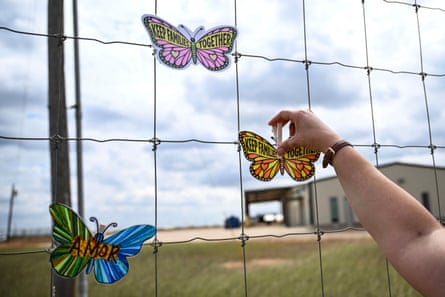
Such detentions “should not be happening”, said Hinojosa, the first Democrat elected Texas governor since 1990 – and the only Hispanic person to ever win the office – in a social media video published on 19 November by Ms Rachel, the children’s YouTube star and activist. “It needs to stop.”
Wednesday marked Charlotte’s 29th day in detention at Dilley, exceeding the 20-day limit for detaining immigrant children set by a federal court in 1985 under a class-action lawsuit that accused the US government of mistreating children in immigration detention. A Texas Tribune analysis from August found that at least 60 children had been detained at Dilley for 100 or more days.
The DHS spokesperson did not provide an explanation for keeping Charlotte beyond the 20-day limit.
Attorney Kristin Etter of the Texas Immigration Law Council, who is representing Karen and her daughter, said Charlotte’s letter to Trump is something no child should ever have to write.
“We are calling on every leader at every level of government and in both parties to demand the release of Karen and Charlotte, close Dilley and end family detention for good,” said Etter, the council’s director of policy and legal services.
‘A nightmare’
As he put it in an interview with the Guardian and Perdido Street, Charlotte’s father said their family did not fit the profile of “dangerous criminals” whom the Trump administration once pledged it would focus its mass deportation efforts on.
The couple had been childhood sweethearts, began living together in 2018 and married in 2022. They financially supported themselves as delivery drivers for the retailer Walmart after arriving in Miami and settling in the New Orleans suburb of Gretna, said Bruno, 27, speaking in Spanish. Charlotte enrolled at William Hart elementary, a public school in Gretna, gaining a proficiency in English that Bruno was hopeful would serve her well.
Bruno said he and Karen, 25, became active in a local Pentecostal church, regularly attending services and retreats. They had no criminal record and paid their share of taxes, he said. And they were hoping to be granted asylum after government corruption, widespread criminal extortions and a general lack of freedom in Venezuela prompted them to try their luck in the US, Bruno recounted.
“We never came to this country illegally,” Bruno said, referring to his family’s arrival in the US seeking asylum under a Biden administration humanitarian parole policy. “We came here looking for a better opportunity, for our family to grow, to fulfill our dreams – and little by little we were [getting] it.”
But the second Trump administration discarded that policy. The US supreme court’s subsequent decision to uphold that termination then removed the temporary protected statuses of more than half a million people and exposed them to removal from the country.
A DHS spokesperson said an asylum application “does NOT confer legal status in our country”. And on 14 October, the spokesperson said, an immigration judge issued a final order of removal for Karen for “failing to show up for her mandatory immigration proceedings”.
Bruno blamed Karen’s absence from those proceedings on a noticing error.
In any event, on 26 October, after she dropped Charlotte off at school and went to the store, she was boxed in by Immigration and Customs Enforcement (ICE) agents in vehicles. “I thought they were going to crash into me,” Karen said in a statement provided by Etter.
She said the agents shouted at her to open the car, which she did. They then violently pulled her out of her car and handcuffed her.
“I thought it was a nightmare,” Karen’s statement said. She also recalled yelling, “my daughter, my daughter” – and unsuccessfully begging to be taken to Charlotte’s school.
Karen said the agents brought her to a garage for initial holding and allowed her a three-minute call to Bruno at about noon that day. Her abrupt silence until then had made Bruno worry that she had perhaps been abducted by kidnappers wanting a ransom – not that learning what had actually happened was a comfort, he said.
Ultimately, Karen’s statement said agents told her that she would suffer if she were detained alone. She said they told her they would bring Charlotte to her if she “signed a paper”.
Karen said she signed, and a family friend brought Charlotte to Karen at about 6pm that day. According to Karen, an officer told her that “if she did anything wrong”, she might not see Charlotte again until she was 21.
The mother and daughter were later put on a plane and did not arrive at Dilley until 3am the following day, going 10 hours without food, Karen said.
‘The most harrowing thing’
Bruno said he has been in as much contact as possible with Karen and Charlotte throughout their detentions at Dilley.
His loved ones’ experiences, as relayed to him, seem to be consistent with other previous reporting of life within the only family detention center in the US, which is operated by the country’s largest private prison contractor, CoreCivic.
According to Bruno, Charlotte loathes processed foods and has struggled with some of the dietary offerings at Dilley. He said she had dropped about 7lbs (3kg) halfway through her first week there, and was down about 15lbs more recently.
Bruno said he understood Karen, in desperation, at one point hid cereal in her and Charlotte’s quarters at the facility. But staff there found it and threw it away, he said.
“That was the most harrowing thing to hear,” Bruno said. “Over the course of a day, she might eat five spoonfuls of rice.”
Texas pastor Dianne Garcia has been visiting Dilley weekly since November 2025 and has had 41 members of her congregation detained there. She has found children losing weight and not eating to be “super common” at the family detention facility.
“It’s not just that they don’t like the food,” said Garcia, who leads the San Antonio-based church Roca de Refugio. Citing American Academy of Pediatrics research, Garcia said: “Any time in detention is harmful for children. It’s also an indicator of the stress that kids are going through.”
The number of people in immigration detention at Dilley has fluctuated over time. But in late August, Joaquin Castro – a Democratic congressman from Texas – said there were 576 people detained at Dilley, with 92 children.
Bruno said he and Karen have been pursuing reviews of her immigration case. Members of their church and community have asked ICE to release Karen and Charlotte pending the outcome of those efforts.
‘Give us an opportunity’
Charlotte and Karen’s ordeal has caught the attention of Troy Carter, a Democratic congressman from New Orleans, who sits on a House committee providing oversight of DHS leadership, management and policy.
Carter said he couldn’t discuss the mother and daughter’s case for privacy reasons. But he acknowledged being aware of what the pair were confronting amid reports from people in immigration detention conveying grueling conditions: including a lack of access to phone calls, temperatures that are too cold, a lack of menstrual care products, not recognizing people’s religious dietary needs and a lack of access to doctors.
He said he was optimistic that House Democrats would be able to implement substantial oversight of Trump’s mass deportation campaign once the majority that the lawmaker’s party won in both congressional chambers takes effect in January.
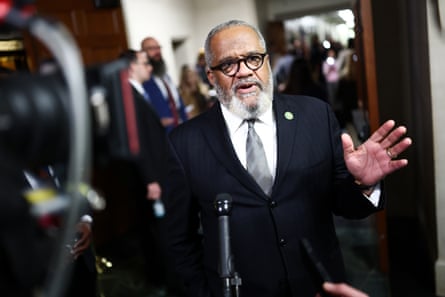
And Carter, favored to then lead the Congressional Black Caucus, said Karen and Charlotte’s case provided a close-to-home example of why ICE needs to be dismantled and replaced with another agency focused on providing a clear path to citizenship for immigrants.
“ICE, as we know it, cannot exist,” Carter said in a recent interview.
Asked what he wanted to tell those in charge of the US’s immigration policy, Bruno said “give us an opportunity”.
“We’ve always had the intention of doing things correctly in this country,” he said. “Ultimately, we are supporting this country – buying things, paying taxes. We are supporting the country and ourselves. So give us a chance to do things right.”
Charlotte, in a statement, said she has been sad to miss out on learning. She said she misses her art class and teacher, too.
She also misses her father and wants to get out so she can give him a hug and play with him, she said.
















Comments