
 German (DE)
  English (US)
  Spanish (ES)
  French (FR)
  Hindi (IN)
  Italian (IT)
  Russian (RU)
  2 hours ago
Democrats have been consumed for the better part of two years by the same question: what went wrong in 2024? Next week, voters in the country’s bluest district will render a verdict when they choose a candidate for the 2026 midterm elections.
Nearly every faultline currently running through Democratic politics – from Gaza and healthcare to immigration enforcement and the role of corporate money in politics – is at the heart of the party’s race for Pennsylvania’s third district.
Encompassing most of Philadelphia’s urban core, this is a district where a majority of residents are Black, several colleges are still processing the aftermath of pro-Palestine campus protests, and all four candidates have called for abolishing US Immigration and Customs Enforcement (ICE).
With Dwight Evans, the congressperson retiring after a decade, the winner of Tuesday’s primary will almost certainly have an easy ride in November’s general election.
The district is a +40 Democratic stronghold, according to the Cook Political Report: Kamala Harris won 88% of its votes in the 2024 presidential election, as the rest of the country re-elected Donald Trump.
And while the shade of blue that tends to win in Philadelphia is often more of the establishment ilk, the political temperature has dramatically increased since Trump’s return to power last January. The traditional wing of the Democratic party, and its insurgents, are now battling over what voters are looking for.
The three viable candidates come from across the party.
Sharif Street, a state senator and the former chair of the Pennsylvania Democratic party and son of John Street, a famously tumultuous former Philadelphia mayor, is the institutional choice, backed by Cherelle Parker, the city’s current mayor, and several trade unions. His campaign rests on his role in creating the health insurance exchange in Pennie, Pennsylvania, and his lawsuits against the Trump administration.
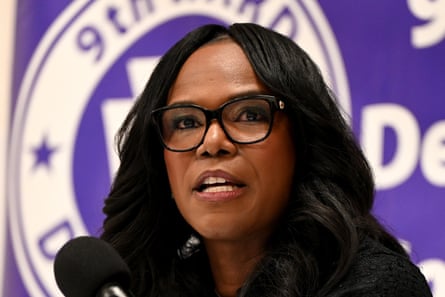
Ala Stanford, a pediatric surgeon who gained national recognition running vaccination sites through her Black Doctors Consortium during the Covid-19 pandemic, is backed by Evans, the outgoing congressperson. She is running as an outsider to electoral politics, on the credibility of having delivered when government did not, though her campaign has faced questions about funding from a pro-Israel lobby group, her organization’s tax filings and an on-camera stumble over ICE that circulated widely on social media.
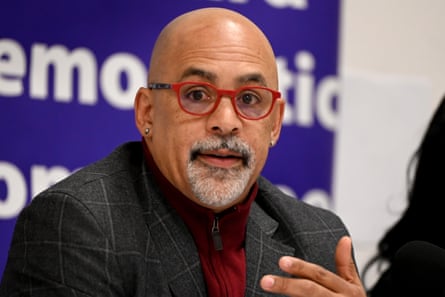
And Chris Rabb, a state representative – endorsed by the congressional progressive caucus, Justice Democrats and the Philadelphia Inquirer editorial board – is running an unapologetically leftwing, grassroots campaign that backs universal healthcare, universal basic income, publicly owned grocery stores, removing big money from politics and ending US military aid to Israel following what he describes as a genocide in Gaza and apartheid in Palestine.
Vowing to end “business as usual” in Washington, Rabb has raised about twice as much as both his main competitors in the primary. “The ideology of machine politics is incumbency and concentration of power,” he said. “I am an aggressively anti-establishment Democrat.”
Representatives for Street and Stanford did not make the candidates available for an interview.
The political evolution of John Fetterman, the Pennsylvania US senator, who won election as a progressive populist in 2022 and then, in the eyes of many former supporters, became something else entirely, looms over this contest. For voters who felt burned by his drift toward Maga adjacency, this primary has stirred a familiar hope – and wariness.
“The F-word in Pennsylvania is not fuck. It’s Fetterman,” said Rabb, who described how he’s heard this worry from district voters – of another elected progressive shifting after their victory – so often that it has come to stick to his soul.
Some party operatives look at Rabb, and this race, the way New York progressives looked at Zohran Mamdani before he won the city’s mayoralty in November 2025: a chance to prove that a genuine leftwing populist can actually reach the top and stay there.
“Philly progressives don’t want to waste the momentum they’re seeing in Maine, Texas and Michigan on another establishment candidate,” said Ryan Birchmeier, a Democratic strategist and former communications director for Eric Adams, the former New York mayor, whose roots began in Philadelphia politics. “They see this as their ‘Zohran moment’.”
The race has also transcended the boundaries of Pennsylvania’s third district, as national Democratic power players – tipped for US presidential runs in 2028 – wade in. Alexandria Ocasio-Cortez, a progressive New York representative, endorsed and fundraised for Rabb, and is set to visit Philadelphia on Friday to campaign for him. Josh Shapiro, the Pennsylvania governor, who has not endorsed anyone publicly, has meanwhile reportedly told allies privately that he disapproves of Rabb and has taken steps to limit his path. Shapiro advised the building trade unions backing Street to avoid running negative ads against Stanford in ways that could fragment the center-left vote, according to Axios.
The governor’s office pushed back against the report. “This is yet another DC story more focused on clicks than the reality on the ground in Pennsylvania,” said spokesperson Manuel Bonder. “The governor has not endorsed or opposed anyone in this primary,” Bonder added, “and he looks forward to working directly with whoever wins.”
On the ground in Pennsylvania, this primary is shaping up to be a key test of whether the “Mamdani moment”, which reshaped New York’s mayoral race and inspired progressives across the US last year, can be replicated elsewhere.
At a campaign event at the Philadelphia Ethical Society last weekend, the US representative Jamie Raskin told Rabb in front of a rapt audience that he was “extremely popular among progressive Democrats in Congress”, adding: “Your agenda is my agenda.”
Outside the building, on the edge of a bustling Rittenhouse Square, Raskin said he was “very much” confident about progressives such as Rabb winning nationwide. “We have a progressive party,” he said. “We need to support a lot of true-blue Democratic candidates. We need to win.”
In the end, Street – the institutional choice – has the infrastructure and the high-profile name recognition, while Stanford has the money and the outgoing congressperson’s blessing. Rabb has “the Squad” of congressional progressives, including Ocasio-Cortez, and the endorsement of the Democratic Socialists of America, even if the state’s governor would apparently prefer him to lose.
Yet Philadelphia is not a city swept up in the minutiae of official-on-official backroom fighting, but one that appears tired of the status quo.
Tyonne Clark, a self-described conservative Democrat who moved from Mississippi a few months ago and works connecting residents to public benefits, has watched up-close what is happening to people who depend on the government. “Some people have diabetes or other illnesses, and their health insurance got completely cut,” he said. “The same day – benefits are being denied, even to the people who qualify.”
He hasn’t made up his mind on his vote just yet, but sees a big benefit in other countries that prioritize universal healthcare, universal education and a living wage. “If you put the infrastructure in place and you make it better for the people in your country, they’re going to make the country better,” said Clark, who pointed to Mamdani in New York as an aspirational model.
Rob Robinson, 65, a New Yorker who moved to Philadelphia in 2022, described himself as a center-seeking Democrat leaning toward Stanford. “She’s a battle-tested professional outside the domain of politics,” he said, “and the need to get away from inside baseball seems to me so profound.”
Stephen Waskiw, 27, who rents in the Museum District and identifies as a moderate liberal, was leaning the other way. “Rabb seems like the most aggressive option for what we need,” he said, “with more of a focus on the community.”
Jane Sagoe, 27, who identifies as a leftist or progressive, said she had received five mailers from Stanford over the last two weeks and two from Rabb. She was leaning toward Rabb.
Not taking money from the American Israel Public Affairs Committee (Aipac) lobby group “already says something about someone’s character as a politician”, she said. But she was clear-eyed about the limits of campaign promises.
“If you reach super far left and then only reach half of those goals, that’s already better than someone who’s left leaning and doesn’t accomplish even a quarter of that,” said Sagoe.
She paused, before saying: “I would like the world to change.”

















Comments