
 German (DE)
  English (US)
  Spanish (ES)
  French (FR)
  Hindi (IN)
  Italian (IT)
  Russian (RU)
  2 hours ago
Colorado is in the midst of an affordable housing crisis. Well over half of low-income Colorado residents are cost-burdened, according to the National Low Income Housing Coalition. That means they spend more than 30% of their pretax income on rent or mortgage payments.
In fact, some 87% of extremely low-income Coloradans, or those who support a family of four on less than US$43,200 per year, are considered cost-burdened.
These high costs are explained, in part, by a significant housing shortage of over 106,000 homes in the state, according to a recent study by the Colorado Department of Local Affairs. This crisis is particularly pronounced in the for-sale market in Denver, where the median home price tops $600,000, which is about 54% above the national median.
Legislators and advocates have proposed different solutions, but it’s not clear which will work.
Some housing experts recommend finding ways to slash regulations, developer fees and overall compliance costs. For example, experts have recommended streamlining permits or fast-tracking approvals for new housing projects.
Other advocates are pushing for rent control or rent regulation to protect current renters and keep privately owned housing affordable. Although rent control legislation failed in 2023, Democrats in the state Legislature are still pushing the idea.
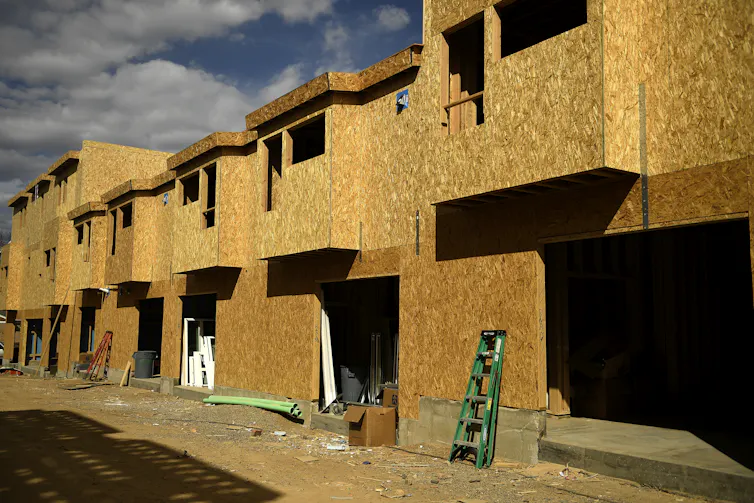
Which public policies will have the greatest success at producing more housing and lowering the cost of housing? We set out to examine these policies and others to understand their potential effects on housing production and affordability in Denver.
We are a law professor and urban planning scholar passionate about policy solutions that promote more affordable housing in Colorado.
How public policies shape housing supply
We study affordable housing policy at the University of Denver’s Center for Housing Research and Innovative Solutions, which launched in February 2026.
To model how various housing policies may influence housing supply in Denver, we partnered with Terner Labs, a housing research center at the University of California, Berkeley, which developed a Housing Policy Simulator that provides crucial information about the possible impact of new policies. The simulator considers project costs, the underlying economic environment and past housing market data.
We fed the simulator 10 different public policies. Each one was a simplified version of a policy that could be implemented in Denver. The simulator then considered economic conditions, such as interest rates, city zoning regulations, recent historical development trends and the economic viability of projects.
The simulator uses this data to generate a probability model, which is a mathematical model that accounts for uncertainties about the future. For example, the model can estimate the likelihood of a developer building market-rate housing that is multifamily. This includes duplexes, apartment buildings or anything other than a single-family home.
The simulator runs thousands of these probability models and ultimately provides a numerical estimate of the number of new units that could be built. It also predicts the average total cost to build those units.
In 1976, statistician George Box wrote, “All models are wrong, but some are useful.” It is notoriously difficult to predict the future. Rather than believing any one of the simulator’s outputs implicitly, we argue that it’s best to consider the outputs relative to one another, or to compare a single public policy across different economic and demographic characteristics.
‘Missing middle’ most promising
With these simulator limitations in mind, we focused specifically on market-rate, multifamily housing policies in Denver.
Among the policies we considered was “missing middle” rezoning allowed without public hearings or approvals.
Missing middle housing is everything excluding single-family detached homes and large apartment buildings. Duplexes, triplexes, quad-plexes, cottage courts and townhomes often fall in the missing middle category.
Housing policy scholars also define missing middle housing as housing serving middle-income people. This refers to people earning between 80% and 120% of the area median income, or the middle household income for a given metropolitan region. Middle density housing offers the possibility of homeownership for this group of people because the housing type is typically more affordable.
Too often, these people are sandwiched between affordable-housing and market-rate housing options. They can’t afford market rate, but they make too much for subsidized housing.
We also examined staff capacity limits in the Denver Permitting Office. Other examples of tested policies include a rent freeze and a new policy allowing denser development in Denver.
The simulator predicted that some of the public policies, like cutting staff at the Denver Permitting Office, would greatly limit housing production. This means that only higher-end housing would likely be built. Scholars have found that with fewer city staff members available to issue permits for projects, timelines increase. This leads to greater uncertainty and higher overall costs for builders and developers.
What would missing middle entail?
Missing middle upzoning emerged as a policy winner. Although Denver is currently experimenting with allowing missing middle housing in specific areas of the city through its Unlocking Housing Choices policy, the upzoning policy we modeled would allow landowners to build more densely on all parcels.
The simulator predicted that this policy had the potential to increase the supply of multifamily market-rate housing in Denver by 46%. It would also reduce the total costs to build a project. Based on cost assumptions used in the simulator, a typical middle density multifamily project would cost about $597,000 citywide. In contrast, a status quo model project for a new multifamily development would cost, on average, around $826,000 per unit to build. We believe the lower costs are due to a larger number of sites available for middle-density housing in Denver.
Our simulator model also found that the opposite public policy – downzoning to decrease density by decreasing the number of units of housing allowed on any given lot – would both limit housing supply and increase average total costs.
In our simulator model, single-family residential zones, which make up nearly 70% of residential land in Denver, are rezoned to allow more density without lengthy approval processes or permissions from the city. This policy encourages slightly denser development. Specifically, the model requires all parcels to allow at least four units. Parcels that already allow more density than that, such as those that allow apartment buildings, are unchanged.

Another important benefit of missing middle zoning policy is that zoning is typically the purview of local governments and does not require extensive involvement from the state or federal government. In Denver, city planners and mayoral staff are committed to increasing housing affordability and density, as seen through policies like Unlocking Housing Choices.
Model limitations and shortcomings
The simulator can rate the relative efficacy of public policies. However, it cannot assess the practical task of policy implementation. It also cannot account for dynamics like neighborhood opposition or resistance that may slow or halt the passage of a policy. It was not programmed or designed to do this.
As urban planning scholars have found, local communities participate extensively in neighborhood politics. These efforts can stop or slow policy changes.
In some cases, opposition might amount to parochial not in my backyard — or NIMBY — concerns. But in other cases, residents may have legitimate concerns about rezonings. These include infrastructure capacity, traffic congestion, pollution and tree canopy concerns, or issues around historical preservation.
While the missing middle policy holds theoretical promise, public attitudes may be moving in the opposite direction. For example, in April 2026, voters in Lakewood, Colorado, struck down a missing-middle style zoning reform. Advocates were concerned about changes to the suburban character of the midsize city just 8 miles west of Denver, according to The Colorado Sun.
Additionally, missing middle and other reforms do not function as a panacea. Multiple housing-policy reforms implemented together, like transit-oriented development, eliminating mandatory parking rules or fee waivers for qualifying sustainable multifamily projects near transit, would greatly increase housing supply.
Read more of our stories about Colorado.





















Comments