
 German (DE)
  English (US)
  Spanish (ES)
  French (FR)
  Hindi (IN)
  Italian (IT)
  Russian (RU)
  3 hours ago
Being the subject of mockery may be the most intense of all Donald Trump’s known aversions.
Yet more than five months after embarking on a war of choice against Iran, the US president risks attracting ridicule as he struggles to secure a military victory – while repeatedly threatening devastating bombardment against the Tehran regime, only to back down on the pretext of renewed negotiations.
Critics suggest the ultimatum-climbdown sequence has acquired a Groundhog Day quality. By one count, he has adopted the same tactic seven times since launching the war in tandem with Israel on 28 February.
Last weekend saw the latest episode, as Trump told reporters onboard Air Force One that he had suddenly called off “a massive” attack that he said would have been “the biggest since world war two” after an appeal from US allies and because “I think there’s a deal”.
Despite negotiations between Iran and Oman over shipping in the strait of Hormuz, no deal has thus far materialized, and the strategically vital waterway – conduit to a fifth of the world’s oil supply before the war – remains closed.
The pattern resembled one that unfolded on a string of other occasions – including Trump’s memorably dire threat in April that Iranian “civilization will die tonight” unless Tehran capitulated to his demands only to retreat at the 11th hour and agree to a ceasefire.
The US president has also claimed multiple times that the US has “virtually” won the war and that Iran’s regime was clamoring for a deal.
Increasingly, such claims are prompting ridicule.
A recent CNN montage showed 14 separate pieces of footage dating back to March, with Trump insisting peace was at hand because Iran’s leaders “want to make a deal” after being supposedly rendered militarily impotent – assertions belied by a continuing Iranian ability to inflict damage on US and allied targets in the Middle East.
The veteran British journalist and commentator Andrew Neil pilloried Trump’s boasts as worthy of the Nobel peace prize he is known to covet.
“He, in the past five months, has brought peace to the Iran war eight times,” Neil said sarcastically on Times Radio. “What more do you have to do to merit a Nobel peace prize?”
He added: “We waste our time even analyzing it, because it’s either meaningless, or he’s done a U-turn on it within 24 hours … You might as well read the shipping forecasts.”
Trump’s wildly zigzagging messaging on the war betrays an absence of strategy and a profound ignorance of his enemy, analysts say – and threatens to deliver an electoral disaster in November’s US congressional midterms.
Mehrzad Boroujerdi, vice-provost and a political scientist at Missouri Science and Technology University, believes the US president’s failure to understand the individuals leading Iran’s authoritarian Islamic system has misled him into a dead end of ineffective and counterproductive threats.
“One of the most terrible mistakes that Trump made was invoking this type of a language,” said Boroujerdi, who argued that regimes who come into being through mass revolutions such as the one in 1979 that swept Iranian revolutionaries to power are much harder to topple than other governments.
“First, these are not people who are going to bend the knee,” he said. “Second, you have just killed the top of their leadership (including the former supreme leader, Ayatollah Ali Khamenei). Their psychology is only an invitation for Trump to become more aggressive.”
Understanding Tehran
Boroujerdi made it his life’s mission to understand the motivations of the men inside the Islamic regime after his father, Malek-Mohammad Boroujerdi, a senior executive with the national oil company, was assassinated by an Islamist guerrilla group in December 1978, on the eve of the revolution that overthrew the western-backed monarch, Shah Mohammad Reza Pahlavi.
He kept his personal stake in scrutinizing the regime under wraps, lest it be seen as impairing the impartiality of his academic studies
Nearly half a century later, key members of the group, the Mansouroun, occupy some of the regime’s most sensitive military posts. They include Mohammad Baqer Zolqadr, secretary of Iran’s supreme national security council, and Mohsen Rezaei, the founding commander of the Islamic Revolutionary Guard Corps, who is now military adviser to the present supreme leader, Mojtaba Khamenei, whose father was killed in an Israeli military strike at the start of the war.
Having compiled over two decades a vast database of about 2,700 members of the country’s elite, Boroujerdi has co-authored a 900-page book, Post Revolutionary Iran: A Political Handbook, that puts its political leadership under the microscope.
Understanding it helps to explain how the outwardly ramshackle regime has withstood US hostility, international sanctions, diplomatic isolation and periods of war over 47 years all while staying resilient, he argued.
“I have looked at their nepotism ties, who is connected to whom,” said Boroujerdi. “These are folks who came from very modest backgrounds. They are predominantly the sons of farmers, peasants. And then secondly, clerics, who basically enjoyed social mobility thanks to the revolution.
“These were mister nobodies who became mister somebodies thanks to the revolution. And therefore, their attachment to this system and wanting to defend this system makes absolute sense because they owe everything they have currently, their whole career, to what this revolution has given them.
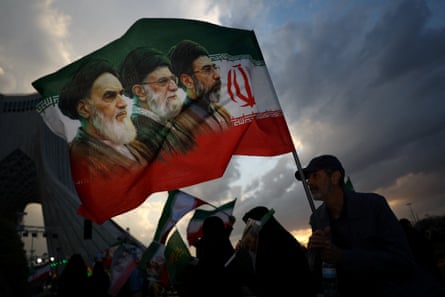
“If we want to understand Iran’s resilience, its performance, we need to better understand the psychology and upbringing of these individuals. But that requires serious work that the political class in Washington isn’t necessarily interested in.”
Having not undertaken such work, Trump has been reduced to railing in frustration at a regime whose defiance is a source of confusion and bewilderment to him.
After a ceasefire agreed in June collapsed over differing interpretations of a memorandum of understanding Trump had signed in the Palace of Versailles, he shocked fellow attenders at last month’s Nato summit in Ankara by calling Iran’s leaders “scum”.
“All they do is make me angry,” he told reporters, while also calling their behavior “unbelievably duplicitous”.
Such incomprehension means Trump’s pattern of ultimately unfulfilled blood-curdling threats is likely to continue, according to Boroujerdi. Other seasoned Iran observers agree.
Ali Vaez, the International Crisis Group’s deputy program director for the Middle East and north Africa, called explaining Trump’s approach in strategic terms “an impossible task” and lamented what he called the lack of a clear policy process in the current administration.
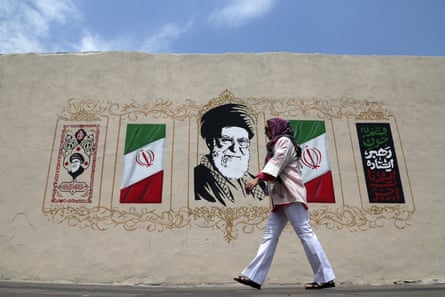
But he also said Iran’s leaders had strengthened their negotiating position in the strait of Hormuz since the collapse of the June ceasefire, while triggering a painful debate in Washington about military choices after recent strikes on a US base in Jordan that killed three US service personnel.
The possibilities for a renewed military onslaught against Iranian targets are believed to be limited because of concerns that US missile and interceptor stockpiles have become depleted.
Trump’s approach “boils down to his frustration that he really doesn’t have any good military options in front of him”, suggested Vaez. “A lot of it is emotional reactions, like when he does a deal with Iran that produces a political backlash, even among Republicans.
“That criticism gets under his skin, so he tries to extract better terms from Iran by bombing them. But when he ends up in an even worse position, he returns to the negotiating table and tries to pursue a diplomatic solution.
“This war started based on a lot of misguided assumptions, which are a clear reminder that half the battle is understanding your enemy – and clearly, President Trump and his administration didn’t understand the enemy.”









Comments