
 German (DE)
  English (US)
  Spanish (ES)
  French (FR)
  Hindi (IN)
  Italian (IT)
  Russian (RU)
  2 hours ago
“If we’re not at the table, we’re on the menu.” The Canadian prime minister, Mark Carney, was the darling of Davos this week as he rallied resistance to Donald Trump’s smash and grab politics and his voracious appetite for other countries’ wealth and land.
“Call it what it is,” he told delegates. “A system of intensifying great power rivalry, where the most powerful pursue their interests using economic integration as coercion”. He urged “middle powers” to band together or be crushed, and was rewarded with a standing ovation.
Attended by thousands of business leaders, politicians and academics, the annual meeting in the Swiss mountain resort is usually focused on the state of the global economy and its toughest challenges, from the climate crisis to inequality.
This year, however, Trump’s dramatic threat to slap tariffs on eight European countries – including the UK, France and Germany – if they failed to back his attempt to seize Greenland, put dog-eat-dog geopolitics centre stage.
Carney’s intervention on Tuesday fanned the hopes of European progressives that a fightback against Trump was under way. Back in London, Labour MPs passed the speech around.
The former Bank of England governor was far from the only voice of resistance audible in Davos. The European Commission president, Ursula von der Leyen, told delegates that “nostalgia will not bring back the old order. And playing for time, and hoping for things to revert soon, will not fix the structural dependencies we have.”
She called on EU governments to “seize this opportunity and build a new independent Europe” by forging new trading relationships and further integrating their financial and energy markets.
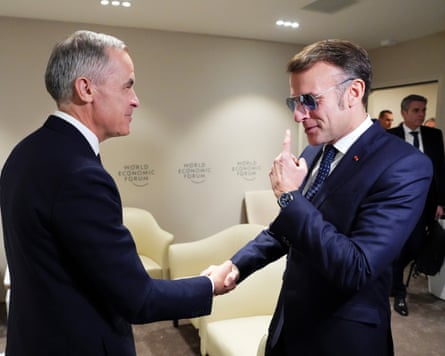
The French president, Emmanuel Macron – sporting aviator shades because of an eye condition – told delegates now was “not a time for new imperialism or new colonialism”. “We prefer respect to bullies,” he said.
By Wednesday lunchtime though, when Marine One landed at a helipad on the outskirts of the ski resort and anticipation built before Trump’s set-piece speech, the main preoccupation among attenders was how to muscle their way into the 5,000-capacity congress hall.
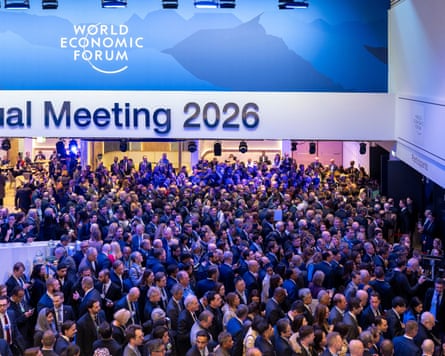
WEF staff armed with megaphones tried in vain to urge calm as CEOs and heads of state joined the throng that packed the lobby and spilled up the stairs.
Those who did manage to make it into the auditorium before the doors slammed shut were met by police and officials ejecting anyone unable to find a precious seat.
As the temperature rose, the BlackRock CEO and interim co-chair of the WEF, Larry Fink, welcomed Trump to the stage before he proceeded to deliver his rambling, invective and racism-laden speech.
There was an audible sense of relief when the US president revealed he would not use military might to take Greenland, but the fear of dissent was palpable among the assembled elite.
Even when he veered into outright racism, describing Somalian people as “low-IQ”, the only criticism came in muttered tones of dismay among some of the delegates.
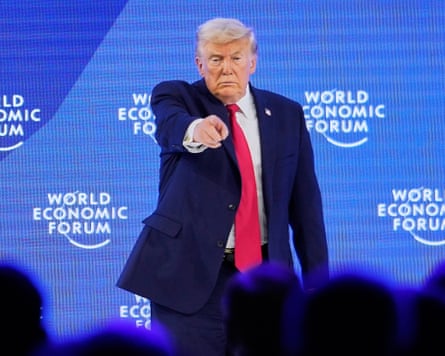
The Trump circus
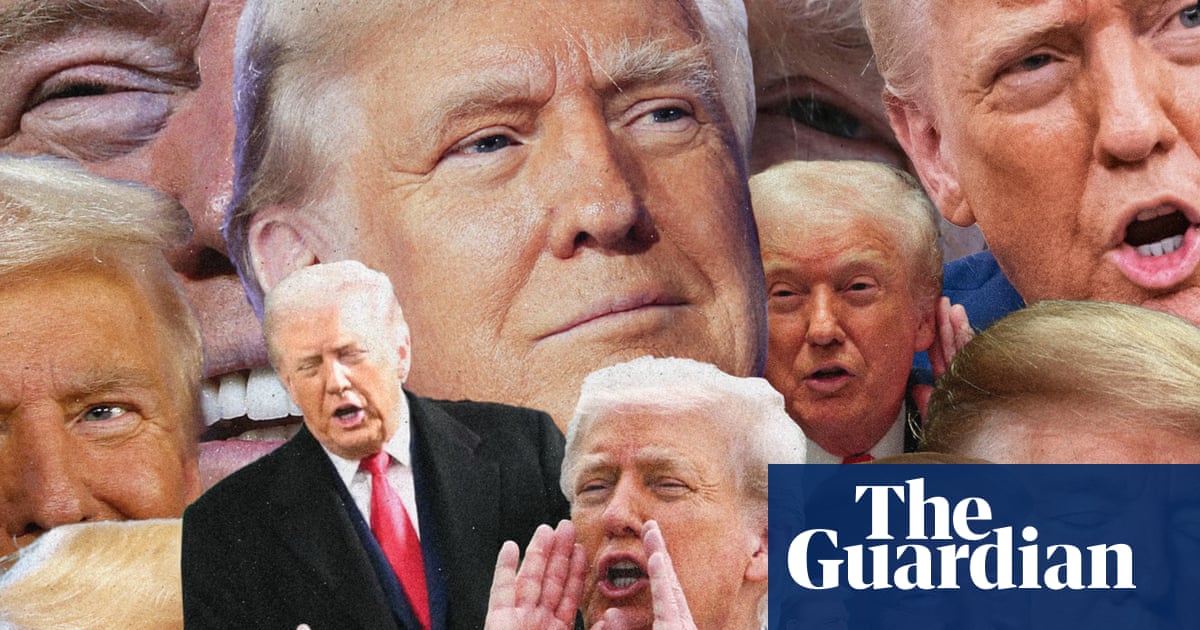
From the moment Trump agreed to attend the annual jamboree, its primary focus, and that of its thousands of attendees, turned to the 47th president of the United States.
US companies snapped up the most coveted slots along the Promenade, the 1.2-mile (2km) road that winds up through the resort to the high-security main congress centre. Google, Uber, Pinterest, LinkedIn, Bank of America, Amazon, IBM, Cisco and Qualcomm were just some of the companies that paid huge sums to convert Davos shops into temporary showrooms.
Proving that God and mammon do mix – certainly when it comes to Trump – a small church opposite the congress centre was converted into USA House, providing a base for US politicians to host press conferences. McKinsey, Microsoft and the cryptocurrency firm Ripple reportedly paid up to $1m (£740,000) each to sponsor the venue.
Armed police patrolled the streets, heavy weaponry was installed at the helipad and some travelling ministers were told to bring their own security rather than relying on Swiss police, who would be preoccupied with protecting the president.
Populists unite
Familiar faces joined Trump’s bandwagon to reject the old order. Argentina’s iconoclastic president, Javier Milei, gave a rambling speech describing the US as a beacon of light for the west.
On Thursday, the longtime WEF critic Nigel Farage was warmly received at an event hosted by Bloomberg.
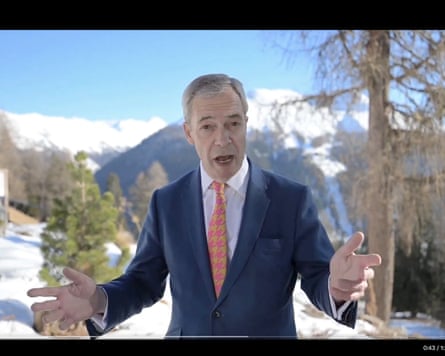
“Five years ago here at Davos, the main topic of conversation was climate change, DEI [diversity equity and inclusion], all that baloney,” he said. “And here we are, five years on, and the debate is completely different.”
Farage said many politicians had assumed the Brexit vote and Trump’s first-term win were a “short-term fit of rage”, but argued it was now clear they were “the first tremors of a very, very major change in political conversation and debate”.
Fear of retaliation, tariffs or having their private messages aired kept most senior politicians – Macron, von der Leyen and Carney aside – in check. Criticism was similarly absent from most chief executives, unless behind closed doors.
JP Morgan’s CEO, Jamie Dimon, tried to dodge questions about whether he agreed with Trump’s economic policies and coercion, only letting the mask slip to admit that the US was now a less trustworthy ally, and that he found some of ICE’s anti-immigration raids troubling. “You had total reliance and now it’s less reliable,” he said.
A day later, Trump sued JP Morgan and Dimon personally for at least $5bn, after accusing the largest US bank of “debanking” him.
Elon Musk, who made a late appearance at Davos, extolled the virtues of solar energy as a vital and cheap way of powering AI datacentres and factories. He studiously avoided calling out Trump’s criticism of renewable power, which the US president labelled a “green scam”.
US tech titans, from Apple’s Tim Cook to Nvidia’s Jensen Huang and Uber’s Dara Khosrowshahi, joined Trump’s entourage. But even worries that their companies could get caught in the economic crossfire – especially if Europe fires its so-called bazooka anti-coercion instrument and restricts US companies’ access to the bloc – were not enough for them to raise their heads above the parapet.
Europe dithers as Ukraine suffers
Until Volodymyr Zelenskyy’s late decision to fly to Switzerland and deliver an address on Thursday afternoon, the war in Ukraine was in danger of slipping right down the WEF agenda.
His fiery speech, in which he accused European leaders of being in “Greenland mode” – waiting for something to come along and rescue them – sent a jolt through the annual gathering. “Just last year, here in Davos, I ended my speech with the words ‘Europe needs to know how to defend itself’,” Zelenskyy said. “A year has passed, and nothing has changed.”
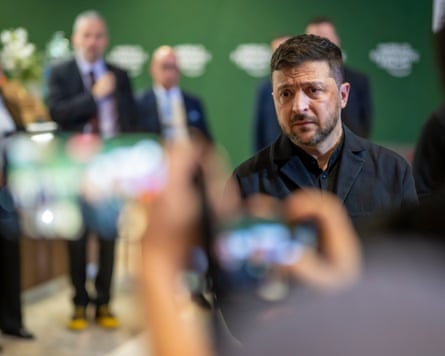
Minds have been focused elsewhere. The biggest European conflict since the second world war has dropped down the priority list for many of the continent’s leaders, and not just because of Trump’s threat to take over Greenland.
“It’s not the top priority for CEOs,” said the boss of an energy company. “Attention spans are short.”
Zelenskyy’s frustration with European inaction also underlined the flaw in Carney’s Avengers Assemble call for an alliance against Trump.
EU nations struggle to agree among themselves – a fact dramatically laid bare on Wednesday, as the European parliament voted to refer the EU’s trade agreement with Latin America’s Mercosur bloc to the European court of justice, potentially delaying its implementation for up to two years. Von der Leyen, who flew to Paraguay to sign the deal, had hailed the agreement in her Davos speech 24 hours earlier as sending “a powerful message to the world”.
Many leaders are also dealing with domestic crises, sluggish economies and are under pressure from populist opposition. Macron flew home to face a vote of no confidence in his government. Keir Starmer, whose tougher line against Trump on the Chagos Islands in the House of Commons on Wednesday was welcomed by colleagues, is trailing Reform in the polls and stayed away from Davos.
Global institutions that might have acted as a counterweight to Trump’s tear-it-all-down approach – from Nato to the World Trade Organization – are struggling to remain relevant as the US trashes the rules.
News that Trump had agreed a deal over Greenland with the Nato secretary general, Mark Rutte, reached Davos delegates as Wednesday evening’s drinks parties were in full swing.
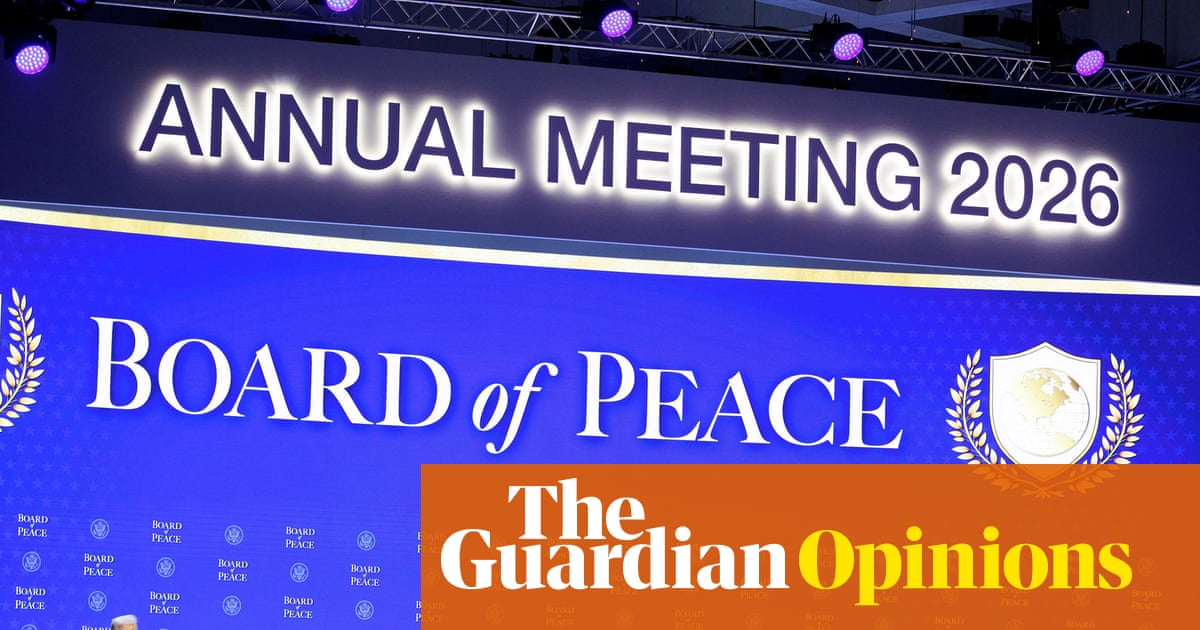
The next morning, as diplomats struggled to work out what had actually been agreed, the schedule in the main WEF congress hall was ripped up to allow Trump to parade politicians from 19 countries in an elaborate signing ceremony for his Gaza “board of peace”.
The event involved another rambling speech, followed by an extended presentation of the administration’s plans for redeveloping the Palestinina territory.
In the end, quiet diplomacy and the power of the markets, rather than rousing speeches, may have staved off Trump’s menacing threat to take Greenland by force. But well before his convoy rolled into town, this year’s Davos felt more like the Trump show than a gathering that is, in the WEF’s words, “committed to improving the state of the world”.
The circus sucked up all oxygen, pushing issues such the climate crisis, the fight against corruption and even the war in Ukraine down the agenda.
“This Davos week we are talking about everything but the essential,” said François Valerian, the chair of the anti-corruption body Transparency International. “Three years ago when I was last in Davos we were speaking about climate, poverty and hunger. Now we are speaking about negotiations under threat, intimidation, war.”










Comments